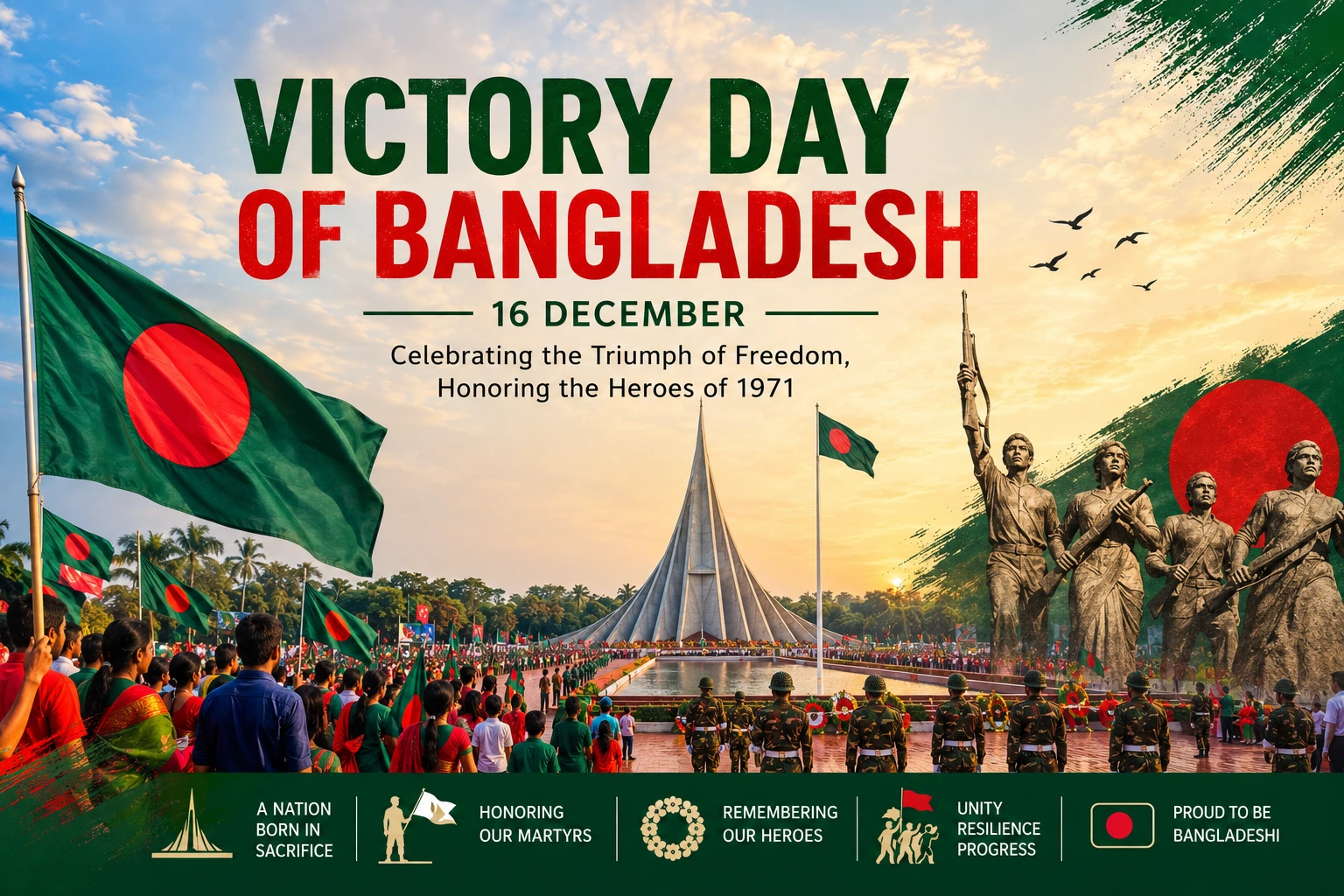
Every nation has defining moments that shape its identity, and for Bangladesh, few dates are as important as December 16. Known as the Victory Day of Bangladesh, this historic day marks the end of the Liberation War of 1971 and the birth of an independent nation after nine months of struggle, sacrifice, and determination.
For Bangladeshis, Victory Day is more than a public holiday. It is a day of remembrance, gratitude, and national pride. Across the country, people honor the martyrs, freedom fighters, and ordinary citizens who contributed to the nation’s journey toward independence.
For international travelers, Victory Day offers a unique opportunity to understand Bangladesh beyond its landscapes and attractions. It provides insight into the resilience, culture, and history that continue to shape modern Bangladesh.
Whether you are interested in history, cultural tourism, photography, or authentic travel experiences, learning about the Victory Day of Bangladesh helps you appreciate the country on a deeper level.
What Is Victory Day of Bangladesh?
Victory Day of Bangladesh is celebrated every year on December 16 to commemorate the surrender of the Pakistani military forces to the joint command of the Mukti Bahini (Liberation Forces) and the Indian Armed Forces in 1971.
The surrender took place at Suhrawardy Udyan in Dhaka, bringing an end to the nine-month Liberation War and officially establishing Bangladesh as an independent nation.
The day symbolizes:
- Freedom from oppression
- National sovereignty
- Cultural identity
- Unity and resilience
- Respect for the sacrifices of freedom fighters
Today, Victory Day remains one of the most significant national celebrations in Bangladesh and is observed with ceremonies, cultural events, parades, and tributes throughout the country.
The Historical Background of Victory Day
To understand the significance of Victory Day, it is important to understand the events that led to the Liberation War.
After the partition of British India in 1947, Pakistan was created with two geographically separate regions: East Pakistan and West Pakistan.
Despite having a larger population, East Pakistan faced years of economic inequality, political exclusion, and cultural discrimination.
The Bengali people increasingly felt marginalized as decisions affecting their lives were made from West Pakistan.
One of the earliest signs of resistance emerged during the Language Movement of 1952, when students and activists demanded recognition of Bangla as a state language. Several protesters lost their lives, but the movement became a symbol of Bengali identity and cultural pride.
The struggle for linguistic and political rights eventually evolved into a broader movement for autonomy and self-determination.
The Road to the Liberation War
The political tensions reached a critical point following the general election of 1970.
The Awami League, led by Bangabandhu Sheikh Mujibur Rahman, won a decisive majority. However, the transfer of power was delayed, creating widespread frustration throughout East Pakistan.
On March 7, 1971, Sheikh Mujibur Rahman delivered his historic speech at the Racecourse Ground in Dhaka. The speech inspired millions and effectively prepared the nation for the struggle ahead.
The situation escalated dramatically on March 25, 1971, when Operation Searchlight was launched. The military crackdown targeted civilians, students, intellectuals, and political activists across East Pakistan.
The following day marked the beginning of the Liberation War.
For nine months, freedom fighters, known as the Mukti Bahini, fought bravely against a much larger military force.
The war became one of the most significant independence movements in modern history.
December 16, 1971: The Day of Victory
After months of intense conflict, international pressure, and military operations, the war reached its conclusion on December 16, 1971.
On that day, Lieutenant General A. A. K. Niazi of Pakistan formally surrendered to Lieutenant General Jagjit Singh Aurora of India at what is now Suhrawardy Udyan in Dhaka.
The surrender marked the end of the Liberation War and the birth of Bangladesh as an independent nation.
Millions of people celebrated in the streets, knowing that their long struggle for freedom had finally succeeded.
This historic moment is why December 16 is celebrated annually as Victory Day of Bangladesh.
Why Victory Day Remains Important Today
More than five decades later, Victory Day continues to hold profound significance.
It reminds the nation of:
- The value of freedom
- The sacrifices made during the Liberation War
- The importance of democracy
- The preservation of cultural identity
- The responsibility of future generations
Victory Day also provides an opportunity to educate younger generations about the events that shaped modern Bangladesh.
Schools, universities, museums, and cultural institutions organize programs that ensure the history of the Liberation War remains alive.
How Bangladesh Celebrates Victory Day
Victory Day celebrations take place across the country.
The day begins with the hoisting of the national flag and the singing of the national anthem.
Government officials, military personnel, educational institutions, and citizens participate in ceremonies that honor the nation’s heroes.
Throughout the day, visitors can witness:
- Military parades
- Wreath-laying ceremonies
- Patriotic concerts
- Cultural performances
- Art exhibitions
- Historical discussions
- Community gatherings
Buildings, monuments, and public spaces are decorated with the colors of the national flag, creating a festive atmosphere throughout the country.
National Martyrs’ Memorial: Honoring the Heroes
One of the most important destinations associated with Victory Day is the National Martyrs’ Memorial in Savar.
This iconic monument honors the millions who sacrificed their lives during the Liberation War.
On December 16, thousands of people visit the memorial to pay tribute to the martyrs.
The architecture, symbolism, and peaceful surroundings make it one of the most meaningful landmarks in Bangladesh.
Visitors interested in understanding the nation’s history should consider including the memorial in their itinerary.
Liberation War Museum: Understanding Bangladesh’s Story
The Liberation War Museum in Dhaka offers one of the most comprehensive introductions to the history of the Liberation War.
The museum contains:
- Historical documents
- Personal artifacts
- Photographs
- Testimonies
- Multimedia exhibits
Visitors can learn about the Language Movement, political developments, humanitarian crisis, and eventual victory that led to the creation of Bangladesh.
The museum provides essential context for anyone seeking a deeper understanding of the country’s journey toward independence.
Suhrawardy Udyan: Where History Was Made
Suhrawardy Udyan holds a special place in Bangladesh’s history.
It was here that:
- Sheikh Mujibur Rahman delivered his historic March 7 speech.
- The Pakistani military surrendered on December 16, 1971.
Today, the park serves as a major historical landmark and remains one of the most important sites associated with the Liberation War.
Visitors often include Suhrawardy Udyan while exploring Dhaka’s cultural and historical attractions.
Those interested in exploring the city’s heritage can combine these experiences with an Old Dhaka Tour or Discover Dhaka City, both of which provide valuable insight into Bangladesh’s cultural evolution.
Experiencing Victory Day as a Traveler
For international visitors, Victory Day offers a meaningful cultural experience.
Unlike many national celebrations focused solely on entertainment, Victory Day combines history, remembrance, and national pride.
Travelers can witness:
- Public ceremonies
- Patriotic displays
- Community participation
- Historical exhibitions
- Traditional performances
The atmosphere provides a unique opportunity to connect with local people and understand the values that define the nation.
Visitors interested in photography often combine the celebrations with a Street Photography Tour in Dhaka, capturing both historical landmarks and contemporary life.
Historic Places Connected to Bangladesh’s Freedom
Victory Day provides an excellent opportunity to explore some of the country’s most important historical destinations.
These include:
- National Martyrs’ Memorial
- Liberation War Museum
- Suhrawardy Udyan
- Central Shaheed Minar
- Ahsan Manzil
- Lalbagh Fort
- Sonargaon
- Panam City
Travelers interested in heritage tourism often enjoy the Old Dhaka and Sonargao Tour, which connects visitors with centuries of Bengali history and architecture.
Those seeking broader historical exploration may also consider the World Heritage and Historical Places Tours, which include some of Bangladesh’s most important archaeological and cultural sites.
Why December Is One of the Best Times to Visit Bangladesh
December is widely considered one of the best months to travel in Bangladesh.
The weather is:
- Cool and comfortable
- Less humid
- Ideal for sightseeing
- Excellent for photography
- Suitable for outdoor activities
Visitors can enjoy cultural festivals, heritage sites, river journeys, and wildlife experiences without the intense heat experienced during other seasons.
Travelers often combine Victory Day experiences with destinations such as the Sundarbans and Bagerhat Tour, where UNESCO heritage sites and the world’s largest mangrove forest create unforgettable travel opportunities.
Others extend their journey to tea country through the Sreemangal and Sylhet Tour, discovering another side of Bangladesh’s natural beauty.
Victory Day and Bangladesh’s Cultural Identity
Victory Day is deeply connected to Bangladesh’s cultural identity.
The values celebrated on December 16 continue to influence:
- Literature
- Music
- Art
- Education
- Public life
The day serves as a reminder that freedom was achieved through collective sacrifice and national unity.
Understanding this history allows visitors to appreciate not only Bangladesh’s past but also the resilience and optimism that characterize the country today.
Experience Bangladesh Beyond Victory Day
While Victory Day is one of the most important events in the national calendar, it also provides a gateway to exploring Bangladesh itself.
Visitors who come to learn about the Liberation War often discover a country filled with:
- Rich cultural heritage
- Historic cities
- UNESCO World Heritage Sites
- Tea gardens
- Rivers and wetlands
- Mangrove forests
- Warm and welcoming communities
Whether you choose a Half-Day Tour Dhaka, a North Bengal Tour, or a broader cultural journey, Bangladesh offers experiences that remain authentic, meaningful, and largely undiscovered by mass tourism.
Frequently Asked Questions
What is Victory Day of Bangladesh?
Victory Day of Bangladesh is celebrated on December 16 to commemorate the victory achieved during the Liberation War of 1971 and the creation of Bangladesh as an independent nation.
Why is December 16 important in Bangladesh?
December 16 marks the surrender of Pakistani military forces in Dhaka, bringing an end to the Liberation War and establishing Bangladesh’s independence.
How is Victory Day celebrated in Bangladesh?
The day is celebrated through military parades, cultural performances, flag-hoisting ceremonies, memorial visits, concerts, and educational events.
What is the difference between Independence Day and Victory Day?
Independence Day on March 26 marks the beginning of the Liberation War, while Victory Day on December 16 celebrates the final victory and establishment of Bangladesh as an independent nation.
What historical places should travelers visit to learn about Victory Day?
The National Martyrs’ Memorial, Liberation War Museum, Suhrawardy Udyan, Central Shaheed Minar, and Old Dhaka are among the most significant locations.
Is December a good time to visit Bangladesh?
Yes. December offers pleasant weather, cultural celebrations, and excellent conditions for exploring Bangladesh’s historical and natural attractions.
Which Bangladesh tours are most relevant for history lovers?
The Old Dhaka Tour, Old Dhaka and Sonargao Tour, World Heritage and Historical Places Tours, and North Bengal Tour are excellent choices for travelers interested in history and culture.